
- By Argentium
- Date
Why Self-Drilling Anchors Are Replacing Conven onal Rock Bolts in Modern Geotechnical Engineering
Every geotechnical project depends on a reliable ground support system. Whether the application involves tunnels, slopes, mining, or deep foundations, the anchoring method chosen directly shapes safety, construction speed, and long-term performance.
For decades, conventional rock bolts have been the standard for stabilization. But as projects increasingly run into fractured rock, loose formations, and groundwater, the limitations of that approach have become harder to ignore.
Challenges with Conventional Rock Bolts
Installing a traditional rock bolt follows a fixed sequence: drill, remove the drill string, insert the bolt, then grout the hole. This works well in competent rock—but it becomes difficult fast in unstable ground.
In weak or collapsing formations, the borehole can deteriorate before the bolt ever goes in. That often means repeated drilling, extra material, longer schedules, and more risk exposure for site personnel.
The Self-Drilling Anchor Advantage
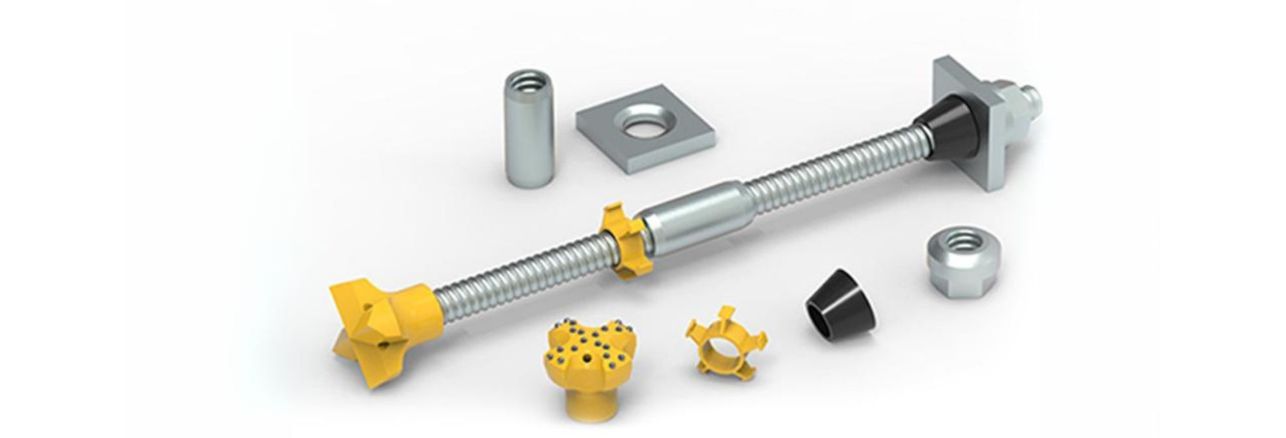
Self-Drilling Anchors (SDAs) were developed specifically to close this gap. Rather than treating drilling and anchoring as separate steps, the anchor itself doubles as the drill rod, with grout injected during installation.
Because the reinforcement is installed as the borehole is being created, the surrounding ground remains supported throughout the entire process. This significantly reduces the risk of borehole collapse and delivers a more reliable solution in challenging geological conditions.
Key Benefits: SDA vs. Conventional Rock Bolts
Faster Installa on SDA: Drilling, anchoring, and groutng happen in a single pass, minimizing installaton time and boostng productivity.
Conventional: Requires separate drilling, cleaning, bolt insertion, and groutng steps — each one adding me and risk of delay.
Performance in Weak Ground SDA: Performs reliably in fractured rock, loose soils, and water-bearing formations.
Conventional: Often struggles in the same conditions, since the open borehole isn’t supported until the bolt is placed.
Load Transfer SDA: Continuous grout injection creates a stronger bond between anchor and ground, giving more efficient load distribution and long-term stability.
Conventional: Bond quality depends heavily on getting the grouting step right afer the fact — leaving more room for a weaker connection.
Safety SDA: Fewer installation steps mean less equipment handling and less worker exposure.
Conventional: Repeating steps — somemes the same operation twice — increases the me workers spend in unstable ground conditions.
Project Cost SDA: Initial material costs may vary, but reduced rework and fewer delays often mean real savings over the life of the project.
Conventional: Re-drilling and schedule delays in difficult ground conditions frequently drive costs higher than expected.
Comparing Conventional Rock Bolts and SDAs
Conventional rock bolts still hold up well in stable geological conditions. But once a project runs into collapsing ground, fractured formations, or groundwater, Self-Drilling Anchors offer the more dependable, more efficient path forward.
Their ability to stabilize the borehole during installation — not after — is what translates into faster construction, better safety outcomes, and more consistent performance where conventional systems start to fall short.
As infrastructure and underground construction projects continue to push into more complex geology, demand for smarter ground reinforcement is only going to grow. Self-Drilling Anchors bring efficiency, safety, and performance together in a single installation process, making them an increasingly practical choice for engineers who need dependable ground support in challenging conditions.

We want to hear from you
Popular Searches
Our Blogs

Our Products
- Mining Equpiment Manufacturer
- Supanchor Self Drilling Anchors
- MEGABolt Self Drilling Anchors (SDA)
- MEGAPole Case Advacing System
- MEGABolt Water Expandable Rock Bolts (ERB)
- MEGA Splice Coupling System
- MEGABolt-GFRP Self Drilling Anchor
- MEGABolt-PT Bar
- Mitsubishi Rock Tools
- Zhuzhou Cemented Carbide Products
- Threaded Bars
- Forepoling Drilling System
- Threaded Rods
- Hollow Roads

WhatsApp us